Meet the REAL AD team: Frida Lenér
June 25, 2026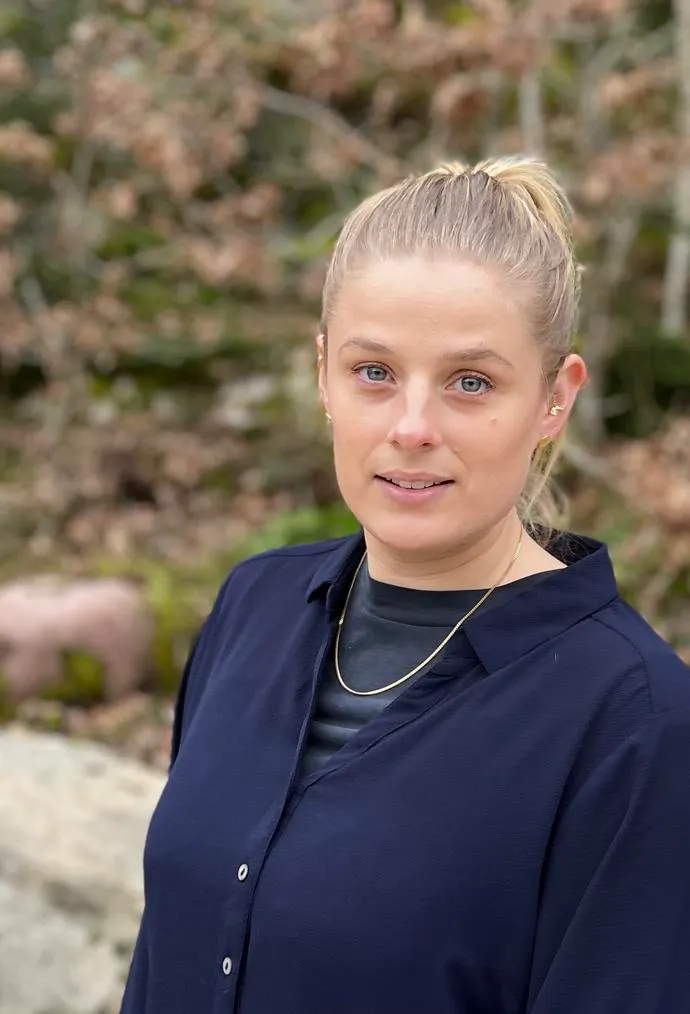
Frida Lenér is a PhD student affiliated with the REAL AD study, where her research focuses on the early detection of Alzheimer's disease in primary care. She is also a member of the REAL AD study management team and has a background as a licensed pharmacist and research coordinator at the centre for research and development primary healthcare Fyrbodal in Region Västra Götaland (VGR).
As the second interviewee of the ‘Meet the team’ series, she answered a few questions.
Was there a defining moment in your life that led to the work you do now?
Yes, there were a few defining moments. The first was a summer evening just after graduating high school, when my best friend said, "Frida, you should study pharmacy and do research”. The second came when my master’s thesis supervisor recruited me to help with research projects on an hourly basis while I was still working as a pharmacist. Over time, the research work grew, and eventually I left the pharmacy for a full-time role as a research coordinator in VGR. One of the projects I was asked to take on was the REAL AD study, right at its inception, when Michael (Schöll) was setting it up. Through REAL AD, I became engaged in Alzheimer’s research, and the line between work and personal interest began to blur. The latest moment came when an opportunity to pursue a PhD in Michael’s research group emerged.
As both a project leader and now a PhD student, what would you say is your favourite aspect of the role?
The problem solving. There is a particular satisfaction in asking, "We really want to do this, so how are we going to do it?" In the early days, the most engaging challenge was designing the practical flows of the study.
My PhD continues in the same vein. I study different aspects of clinical usage of blood-based biomarkers and digital cognitive assessments for Alzheimer’s diagnostics in primary care. For example, healthcare professionals’ experiences of using these methods and their health-economic implications. In other words, I am interested not only in whether these methods improve diagnosis, but also in what they mean in terms of time, resources, and costs for our healthcare system.
What is a milestone or achievement within the study that you are proud of?
The launch stands out. I was on parental leave at the time, yet it was extraordinary to hear the study discussed on the radio and to read about it in the newspapers; the publicity and the fact that so many dedicated people got involved and signed up as participants, gave it an almost surreal feeling.
The REAL AD days are another highlight. Because the study is fully remote, meeting the participants in person is what I miss most. They are wonderful and enthusiastic, and without them none of this would have been possible.
When you envision the future of the REAL AD study, what do you wish it can accomplish?
That the data we are gathering will be analysed by talented current and future researchers, each contributing their knowledge and energy to deepen our understanding of Alzheimer’s disease.
These new diagnostic methods could enable earlier and more accurate diagnoses, potentially leading to better care, improved health outcomes, and more efficient use of healthcare resources. My hope is that the evidence generated by REAL AD will lead to real benefits for patients and their families as well as for the healthcare systems in the near future.
Lastly, what is the one (or more) thing(s) you consistently do to support your brain health?
With a two-and-a-half-year-old at home, there is endless fun and love, but probably also some decline in my current brain health due to the constant readiness required to chase after this small, energetic human and save either him or the surroundings, haha.
I recharge by being out in nature, either by running on winding forest trails or across rocks by the sea, where your mind is occupied by the need to make quick decisions about where to place the next step. And, most of all, through horseback riding—going out with loose reins at full gallop makes everything grow still.

A photo of Frida with her former horse, Nemo.